Landscape
Firoozeh
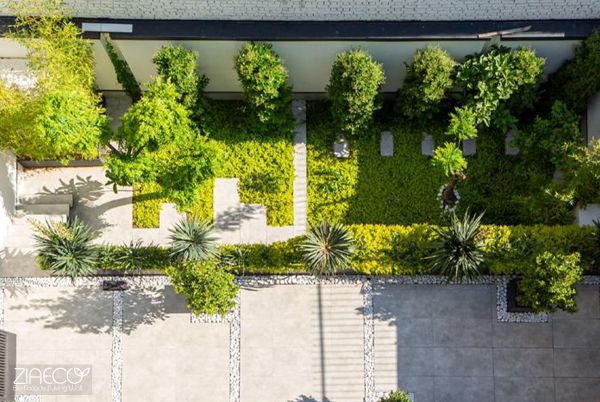
A Mansion with Tall Grasses
Houseplants, with their simple yet intricate foliage patterns, play an important role in shaping the temporal experience of spaces. Their daily and yearly rhythms offer residents a sense of reassurance, suggesting that things will settle and return to a balanced state. In this way, indoor plants soften the impact of urban and human changes, constantly reminding inhabitants that spring will come again, followed by autumn and winter.
The cyclical changes in nature, trees, and the sky signal a return—not to exactly what once was, but to a renewed state. Each time, both the appearance of the tree and the inner states of individuals shift. Yet amid this transformation, one thing remains constant: a living, evolving relationship with the tree, experienced like a faithful friend before the eyes of the residents.
Khane-Khani – Ali Tabatabaei
Beautiful Hermes
The Beauty of Trees and Plants Alongside a Tall Tower
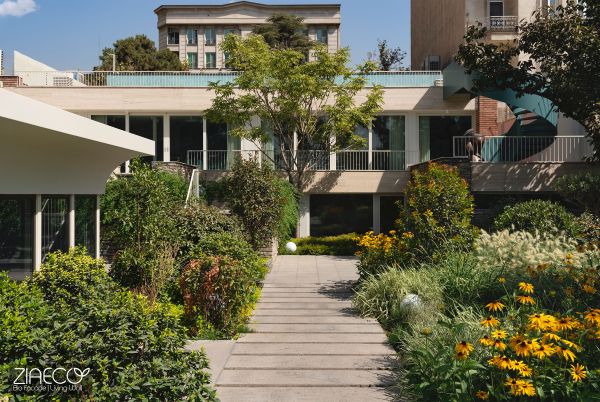
In the landscaping design of Hermes Tower Garden, a smart blend of nature and modern architecture has been implemented to create a balance between urban life and the natural environment. The landscape is designed for residents to easily enjoy and relax in a peaceful, natural setting. Additionally, well-planned pathways provide access to all parts of the garden, ensuring that residents can reach every corner of the green space.
Beautiful Hermes
Freshness of Leaves and Trees
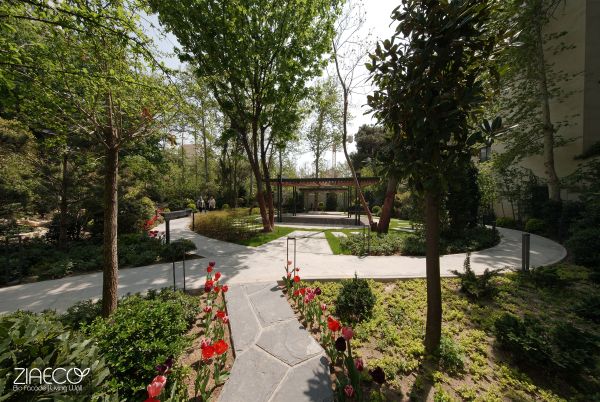
This project has created a new garden within the old one, preserving and respecting the existing mature trees. The new trees, clearly distinguishable from the old ones, are planted in smaller sizes and, when tall, are placed in special frames to highlight the differences. Trees and shrubs have been planted using an island-style approach rather than a sculptural one. Diverse plants grow together, forming volumes of lush greenery.
VIP Exchange
A Green Connection Between Interior and Exterior
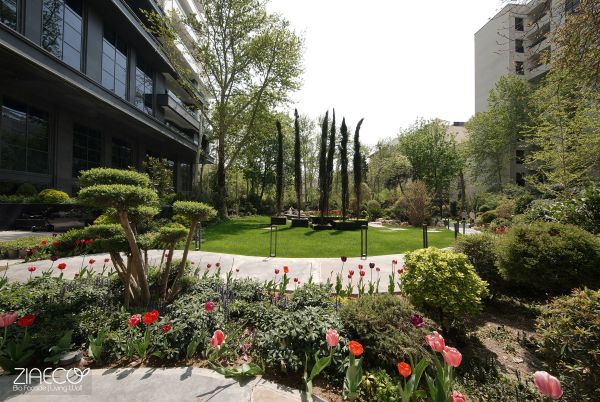
The main design challenge was to maximize the potential of each unit’s connection to the exterior while respecting the boundaries between private and public spaces. To address this, the spaces were arranged in transparent layers, with an intermediate layer separating the two main zones of the project: public and private areas. This intermediate space also provides access to upper and lower levels.
As a result, the sequential transparent layers create continuity between different spaces, giving the two exterior green areas—located to the north and south of the complex—a more prominent role in shaping the overall environment. At the same time, natural daylight is maximized throughout the interiors. Consequently, the southern courtyard garden is visually connected to the northern sidewalk greenery through multiple transparent layers, allowing views of both spaces from virtually every point within the complex.